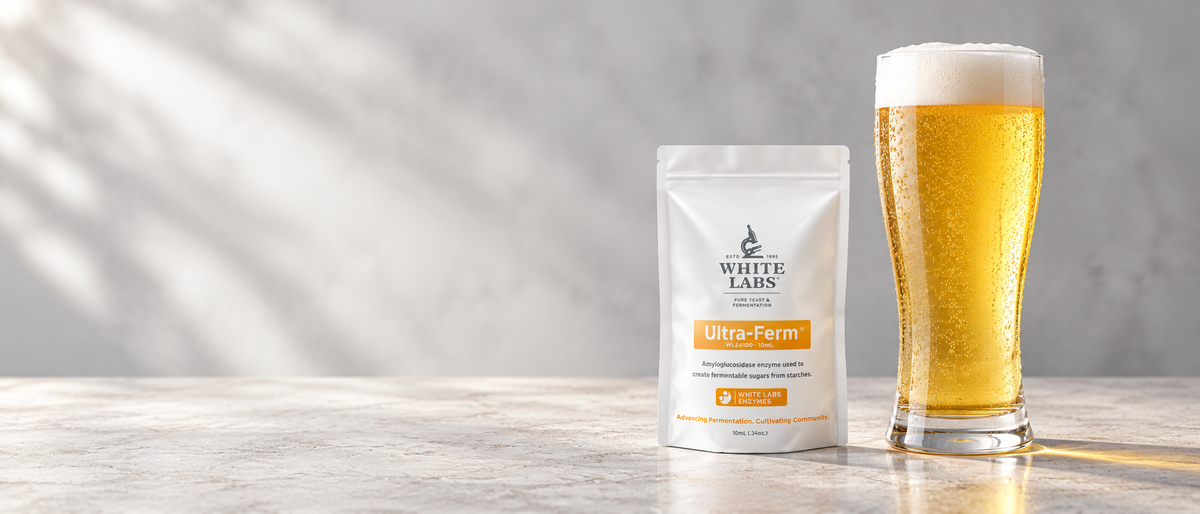
Would you like a light beer with fewer carbohydrates, or a stronger and drier beer from the same recipe you always brew? Both come down to the same thing: how much of the sugar in the wort the yeast is able to turn into alcohol.
Ordinary brewer's yeast can't eat everything. Part of the sugar is dextrins, long sugar chains that stay in the beer and give it body and a touch of sweetness. With the enzyme Ultra-Ferm from White Labs, the dextrins become fermentable too. Here we explain how to use it for low-carb beer, stronger beer and stuck fermentations, and what you need to watch out for.
In short
Ultra-Ferm is the enzyme amyloglucosidase, which turns dextrins into sugar the yeast can ferment. The beer then ferments out completely, often to an FG (Final Gravity) of around 1.000. If you use less malt, you get a low-carb beer with fewer calories and normal alcohol strength. If you use the same recipe, the beer becomes stronger and drier. Add 10 ml per 20 litres straight into the fermenter, and wait until the hydrometer shows the same reading several days in a row before you package, because the enzyme keeps working as long as there are dextrins left.
What is Ultra-Ferm?
Ultra-Ferm is liquid amyloglucosidase, also known as amigase or glucoamylase. The enzyme cuts the dextrins into glucose, which the yeast ferments just as easily as any other sugar. According to White Labs, it breaks the dextrins down completely.
Without the enzyme, a typical beer usually finishes at an FG between 1.008 and 1.015, depending on the yeast and the mash temperature. What remains is mainly dextrins. With Ultra-Ferm almost everything ferments out, and the FG ends up around 1.000. The beer becomes drier and lighter in body with less residual sweetness, while the alcohol goes up.
One 10 ml pack is enough for 20 litres of beer.
 WLE4100 Ultra-Ferm 10 mlOne pack is enough for 20 litres of beerView product →
 LITE Lager all-grain beer kitLow-carb pilsner, 5.1%, Ultra-Ferm includedView product →
 Pilsner Lite 20L Fresh Wort KitLow-carb pilsner with the enzyme already in the wortView product →
 Hydrometer with test tubeShows when fermentation is completely finishedView product →
What can you use Ultra-Ferm for?
| Use | How to do it | Result |
|---|---|---|
| Low-carb beer | Less malt than usual, Ultra-Ferm in the fermenter | Normal alcohol strength, fewer calories and almost no residual sugar |
| Stronger beer | Same recipe, Ultra-Ferm in the fermenter | Higher alcohol, drier and lighter beer |
| Brut IPA | Pale malt base, plenty of aroma hops, Ultra-Ferm | Bone-dry IPA with an FG around 1.000 |
| Stuck fermentation | Ultra-Ferm when the reading is stuck too high | Fermentation continues, often further than the recipe |
How do you brew low-carb beer with Ultra-Ferm?
The carbohydrates in finished beer are mostly the dextrins the yeast couldn't eat. If you ferment them out, you're left with a beer with very little residual sugar. The trick to keeping the alcohol strength at a normal level is to use less malt than in a regular recipe. Since all the sugar gets fermented, you need less of it to reach the same alcohol percentage.
The LITE Lager all-grain beer kit is built this way. With only 4 kg of malt, the beer starts at OG 1.039, ferments all the way down to FG 1.000 and finishes at 5.1%. According to the recipe, that gives about 35 kcal per 100 ml, which is lower than a regular pilsner. The kit is fermented with LalBrew NovaLager for 14 days at 18°C, and Ultra-Ferm is included.
If you'd rather skip the brew day, the Pilsner Lite 20L Fresh Wort Kit is the easiest route. The wort is brewed by Amundsen Bryggeri and already has the enzyme added, so you shouldn't add any more. With High Voltage kveik the beer is fully fermented in three days at 31–35°C and finishes at FG 1.002 and 5.3%. Read more about the kveik in our article on pilsner in three days with High Voltage.
How does Ultra-Ferm make beer stronger?
If you brew the same recipe as before and add Ultra-Ferm, more of the sugar turns into alcohol. As a worked example, a beer with an OG of 1.050 that normally finishes at FG 1.012 comes out at around 5.0%. If it ferments all the way down to 1.000, it ends up at around 6.6%. How much the alcohol rises depends on how many dextrins the recipe has to begin with.
At the same time, the beer becomes drier and lighter in body. That suits pilsners, pale lagers, saisons and brut IPA, which is a bone-dry IPA with lots of hop aroma and almost no sweetness. It is a poor fit for beers that are meant to have body and sweetness, such as stout, porter, bock and most dark beers.
You can also use Ultra-Ferm with a Fresh Wort Kit. Add the enzyme to the fermenter together with the yeast, and the beer will be drier and stronger than the recipe states. Keep in mind that the alcohol goes up and that the beer will no longer taste exactly like the original.
Can Ultra-Ferm rescue a stuck fermentation?
Yes, when what remains is dextrins. This happens, for example, after a high mash temperature, where the wort has ended up with more unfermentable sugar than usual. The hydrometer then gets stuck at a reading higher than the recipe's FG, even though the yeast is healthy. Ultra-Ferm makes the dextrins fermentable, and the yeast can carry on.
Be aware that the beer will then ferment out further than normal. The enzyme doesn't stop at the recipe's FG but keeps going until the dextrins are used up. The beer therefore turns out drier, lighter and stronger than planned, and the FG often ends up close to 1.000.
Always check for other causes first. If fermentation has stopped because it's too cold, because the yeast is too old, or because there was too little yeast, the enzyme alone won't help. Warm the beer up to the yeast's temperature range, and add fresh yeast if needed. Read more about temperature control during fermentation.
How do you use Ultra-Ferm in the fermenter?
- Add 10 ml per 20 litres straight into the fermenter, ideally at the same time as the yeast. For a stuck fermentation, add it once you see that the reading is stuck.
- Ferment as usual at the temperature your yeast needs.
- Give it time. The enzyme works more slowly at fermentation temperature than in the mash, so fermentation may take a few days longer than you're used to.
- Measure with a hydrometer until you get the same reading several days in a row, then give the yeast a couple of extra days to clean up off-flavours.
- Bottle or keg only once you're sure fermentation is finished.
White Labs also describes using it in the mash at 55–60°C. The enzyme is then destroyed during the boil, so its effect stops before fermentation. We recommend the fermenter, because it works with both all-grain and Fresh Wort Kits.
Why do you need to wait before bottling?
In the fermenter the enzyme is never heated, so it isn't destroyed. It keeps breaking down dextrins as long as there are any left. If you bottle before everything has fermented out, the yeast can carry on in the bottle. You then get more carbonation than the priming sugar alone should give, and in the worst case the bottles can burst.
Wait until the hydrometer shows the same reading several days in a row. If you're in doubt, a keg is the safer choice, because you control the pressure with the regulator. Read more about carbonating beer in a keg.
Common mistakes
Packaging too early. The enzyme is still active in the beer, so it isn't enough for the reading to have been the same for just one day. Measure over several days, and be extra careful with bottles.
Expecting the same alcohol strength as before. With the same recipe the beer gets stronger, so if you want the same strength, you need to use less malt.
Using it in beers that need body. Stout, porter and bock turn thin and dry. Ultra-Ferm works best in pale, dry beers.
Adding enzyme to Pilsner Lite. The wort already contains glucoamylase, so you don't need any more.
Thinking the enzyme fixes every stuck fermentation. If the problem is cold, old yeast or too little yeast, that has to be sorted out first.
Get started
If you want to try low-carb beer without writing the recipe yourself, the LITE Lager all-grain beer kit is a safe place to start, and the Pilsner Lite 20L Fresh Wort Kit is the quickest. If you want to make your own favourite drier and stronger, all you need is WLE4100 Ultra-Ferm and a hydrometer, so you can see when fermentation is completely finished.
Sources
- White Labs: "Ultra-Ferm (WLE4100)", product page and product sheet, whitelabs.com.
- Brewshop: product data for the LITE Lager all-grain beer kit and Pilsner Lite 20L Fresh Wort Kit.