
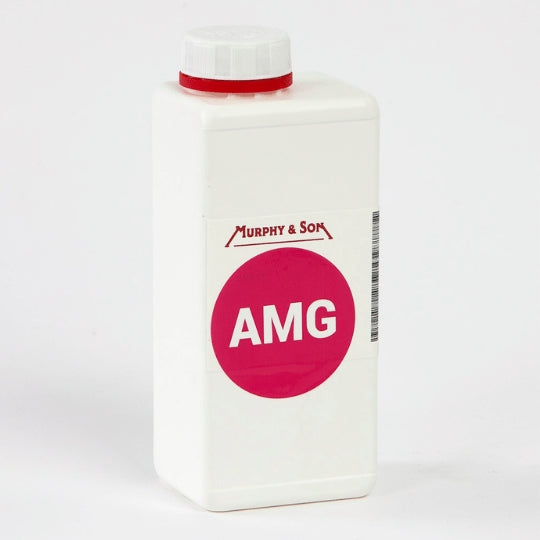

Description
AMG 1 kg ("Amigase") – enzyme for bone-dry beer and higher attenuation
AMG (Amyloglucosidase 300) from Murphy & Son is a glucoamylase enzyme that converts dextrins into fermentable sugars. It is popular with brewers making "low-carb", super-dry beers and Brut IPA, and with distillers who want to increase alcohol yield. It is also known as Amigase.
Please note: This product is only available in Norway.
Read more about AMG in the Murphy & Son blog post "Brut IPA you say?".
Benefits
- Increases attenuation and alcohol yield
- Improved wort fermentability, with RDF above 83% depending on processing
- Better filterability
- Shorter process time
How to use AMG
AMG can be added to the mash, the kettle, the fermenter or post-fermentation, depending on the application. Murphy & Son gives these typical rates:
- In the mash: 0.3–0.6 kg per tonne of dry grist
- In the fermenter, for low-carb beers: 3–8 g per hl of wort, depending on temperature, time, desired attenuation and sugar spectrum
Experiment to find the lowest effective rate. Read the safety data sheet before use and avoid skin contact.
Technical data
- Enzyme: amyloglucosidase (glucoamylase), from a selected strain of Aspergillus
- pH range: 3.5–5.5, best at pH 4.5
- Temperature: effective at fermentation temperatures, best at 40–65 °C and optimal at 60 °C
- Inactivation: rapid above 80 °C. At pH 4–5 the enzyme is inactivated at 95 °C for 10 seconds or at 80 °C for 30–60 seconds
- Storage: 1–10 °C, do not freeze. Keep dark and sealed
- Shelf life: 2 years from date of manufacture at the recommended temperature
- Pack size: 1 kg
Frequently asked questions about AMG
How much AMG should I use?
In the fermenter the typical rate is 3–8 g per hl of wort for low-carb beers. In the mash it is 0.3–0.6 kg per tonne of dry grist. Test to find the lowest rate that gives the result you want.
When should I add AMG?
The enzyme can be added to the mash, the kettle, the fermenter or post-fermentation. For bone-dry beers such as Brut IPA it is often added in the fermenter.
Why does the beer become drier?
AMG breaks down dextrins, which the yeast otherwise cannot use, into glucose. The yeast can then ferment more of the sugar, and the beer becomes drier and stronger.
How do I stop the enzyme?
With heat. At pH 4–5, AMG is inactivated at 95 °C for 10 seconds or at 80 °C for 30–60 seconds.
How do I store AMG?
At 1–10 °C, dark and sealed. The enzyme must not be frozen and keeps for 2 years from the date of manufacture.
Related
Betaling
Your payment information is processed securely. We do not store credit card details nor have access to your credit card information.