
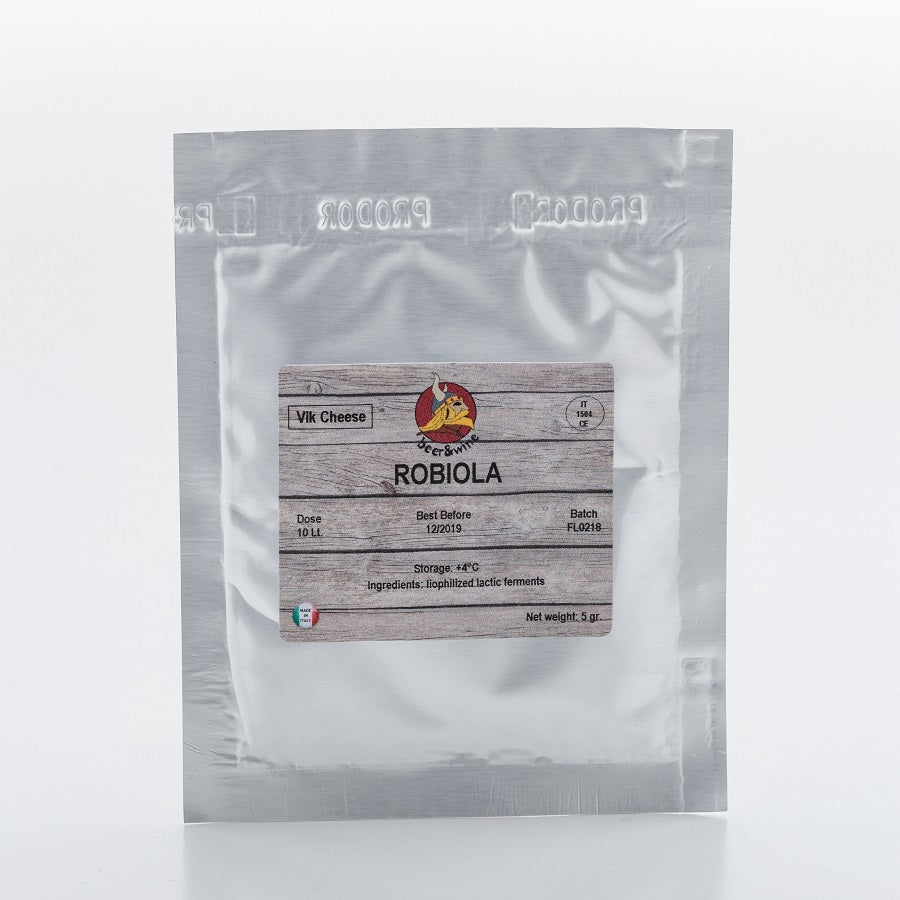

Description
Robiola culture for 10 litres of milk – make soft, creamy cheese at home
Starter culture for making Robiola, a traditional Italian cheese made mainly in Piedmont, but also in Lombardy. Robiola is a soft and creamy cheese with a mild yet complex flavour. One pack is enough for 10 litres of milk.
Robiola can be made from cow's, goat's or sheep's milk, or a blend. When well matured, the cheese often becomes spreadable, and the flavour ranges from mild and delicate to full and slightly tangy, depending on ripening time and type of milk. The thin rind is edible and can be white or slightly orange. Well-known varieties are Robiola di Roccaverano, a DOP-protected cheese from Piedmont, and Robiola Due Latti, made from two types of milk.
How to make Robiola
The producer's recipe book describes the method. In short:
- Optionally pasteurise the whole milk at 72 °C for 15 seconds.
- Add the culture when the milk has cooled to 38 °C and leave for 5 minutes.
- Add rennet at a coagulation temperature of 34 °C. The curd is ready after 18–20 minutes.
- Cut the curd gently, let it rest and fill it into moulds kept at 35 °C.
- Turn the cheese several times during the first hours, then ripen it at 8 °C and 80 % humidity.
- Salt in a 20 % brine for about 1 hour per kilo of cheese.
Serving
Robiola is delicious on its own with fresh bread or crackers, and pairs well with fruit, honey and nuts. In cooking it is used in filled pasta and risotto, where its creamy texture shines.
Frequently asked questions about Robiola culture
How much milk is the culture for?
One pack of culture is for 10 litres of milk.
Do I need rennet as well as the culture?
Yes. The recipe uses rennet, added when the milk is at 34 °C. You can choose calf rennet or vegetable rennet.
What milk can I use for Robiola?
Robiola can be made from cow's, goat's or sheep's milk, or a blend of these. The recipe in the book is based on whole milk.
Does the milk have to be pasteurised?
It is optional. The recipe describes pasteurising at 72 °C for 15 seconds before the culture is added at 38 °C.
Related
Betaling
Your payment information is processed securely. We do not store credit card details nor have access to your credit card information.