

Description
Vegetable fermentation kit – complete kit from Enolandia
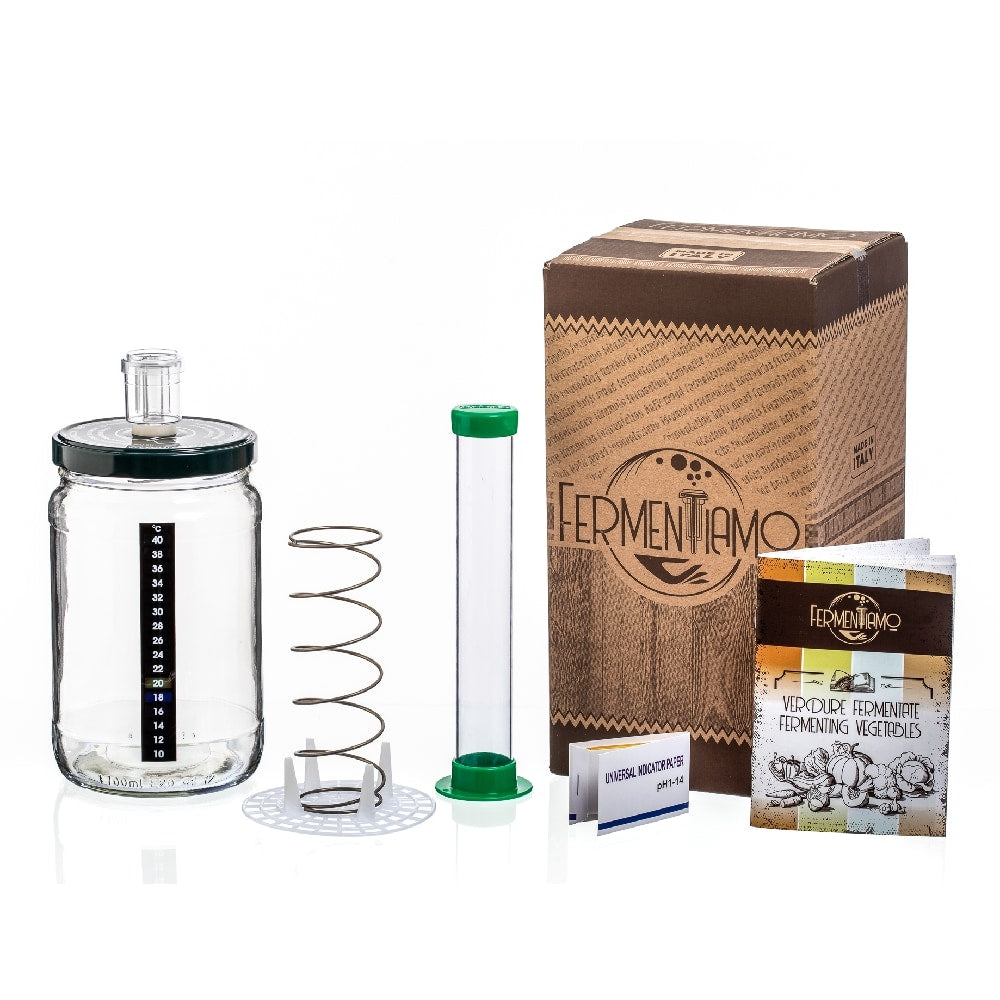
With the MAXI Kit for Fermenting Vegetables from the Italian brand Enolandia, you can easily ferment vegetables at home. The kit has what you need to make sauerkraut, kimchi and other fermented vegetables: a jar with a press that keeps the vegetables below the liquid, a valve that releases gas, and a thermometer and pH strips to follow the fermentation.
Fermentation preserves nutrients, promotes good lactic acid bacteria and gives the vegetables a full, tangy flavour.
The kit contains
- 1.7 L fermentation jar
- spring with press
- self-adhesive thermometer
- compact mini valve with seal
- pH indicator strips
- detailed instructions
Three simple recipes
Homemade sauerkraut
- Shred 1 kg white cabbage and mix with 20 g salt.
- Press the cabbage down into the jar, add the weight and leave it to ferment for 1–2 weeks at room temperature.
Kimchi with Korean chilli
- Cut 1 kg Chinese cabbage and mix with 30 g salt. Leave for 2 hours.
- Rinse, then mix with 3 tbsp gochugaru (Korean chilli flakes), 3 cloves garlic, 1 tbsp ginger and 1 tbsp fish sauce.
- Pack tightly into the jar and ferment for 5–7 days.
Fermented carrots with ginger
- Cut 500 g carrots into sticks and place them in the jar.
- Add 1 tsp grated ginger and 10 g salt dissolved in 5 dl water.
- Leave to ferment for 5–7 days, until the flavour is how you like it.
Frequently asked questions about fermenting vegetables
How long should the vegetables ferment?
It depends on the recipe. Sauerkraut needs 1–2 weeks at room temperature, while kimchi and carrots are ready after 5–7 days. Taste as you go.
How much salt should I use?
The recipes above use 20 g salt per kilo of white cabbage and 30 g per kilo of Chinese cabbage. For carrots, 10 g salt is dissolved in 5 dl water.
What are the press and valve for?
The press keeps the vegetables below the liquid. The valve releases the gas produced during fermentation.
What are the pH strips and thermometer for?
The thermometer shows the temperature in the jar, and the pH strips let you follow how sour the fermentation has become.
Related
Betaling
Your payment information is processed securely. We do not store credit card details nor have access to your credit card information.