Cleaning may not sound very exciting, but it is actually one of the most important elements of the beer brewing process. Cleaning your brewing equipment and thoroughly washing your beer bottles is crucial for a good end result. For a new brewer, it can be hard to know which cleaning equipment is necessary.
Good hygiene makes good beer
To avoid off-flavours and sour beer, good hygiene is the most important part of brewing. Everything that comes into contact with the wort after the boil must be clean and, not least, sanitised. Without going deep into microbiology, we go through some cleaning products here along with a few tips and tricks.
Cleaning brewing equipment
Anything dirty should of course be rinsed off well before a proper wash, preferably as soon as possible after use. This is called pre-rinsing, and includes: fermenters, brewing machines and kettles, kegs, reused bottles and all other equipment that will be used again. If equipment is left too long without being washed, residues will dry on and become difficult to clean later. It will also become a breeding ground for unpleasant bacteria, mould and wild yeast.
There is a lot of waiting time during a brew day. Use this time to wash equipment as you go, and there will be less work at the end of the day!
Alkaline cleaner
The world's most widely used cleaner for cleaning and washing everything from brew kettles and fermentation tanks to bottles is PBW (Powdered Brewery Wash). It is a powerful alkaline, non-caustic cleaner that dissolves organic material. It can safely be used on most materials, including soft metals such as copper, aluminium and brass. For the best possible effect, it should be mixed with water at around 60°C. Scrub well, or leave it to soak for a while if something is very dirty. After use, it should be rinsed out well with water at the same temperature.
There are also other options, such as Chemipro Wash. This is basically very similar to PBW and can easily be used as a direct replacement. Cleaners designed for brewing equipment have a higher content of the right active ingredients and are far more effective at breaking down residues from the brewing process than ordinary dishwasher powder. Dishwasher powder also often contains rinse aid and the like, which is not ideal.
Chemipro Oxi is a product that in many ways resembles PBW, but is formulated slightly differently. Oxi uses active oxygen to clean and can also be used as a sanitiser. Nor is there any need to rinse out Chemipro Oxi after use, as it is not as strong as PBW. For light cleaning this can be a good alternative, for example for cleaning kegs that are not heavily soiled.
Alcohol-based cleaners
Alcohol-based sanitisers, such as Sirafan Speed, are mainly used for items that cannot tolerate acid-based sanitisers. Brass, for example in parts of the uKeg, will corrode on contact with acid. They are also widely used in the food industry for sanitising benches and surfaces.
Sanitising brewing equipment
Even though cleaning removes dirt and microorganisms, it is still necessary to sanitise everything that comes into contact with wort or beer on the cold side. The most commonly used products for this are acid-based sanitisers such as Star San.
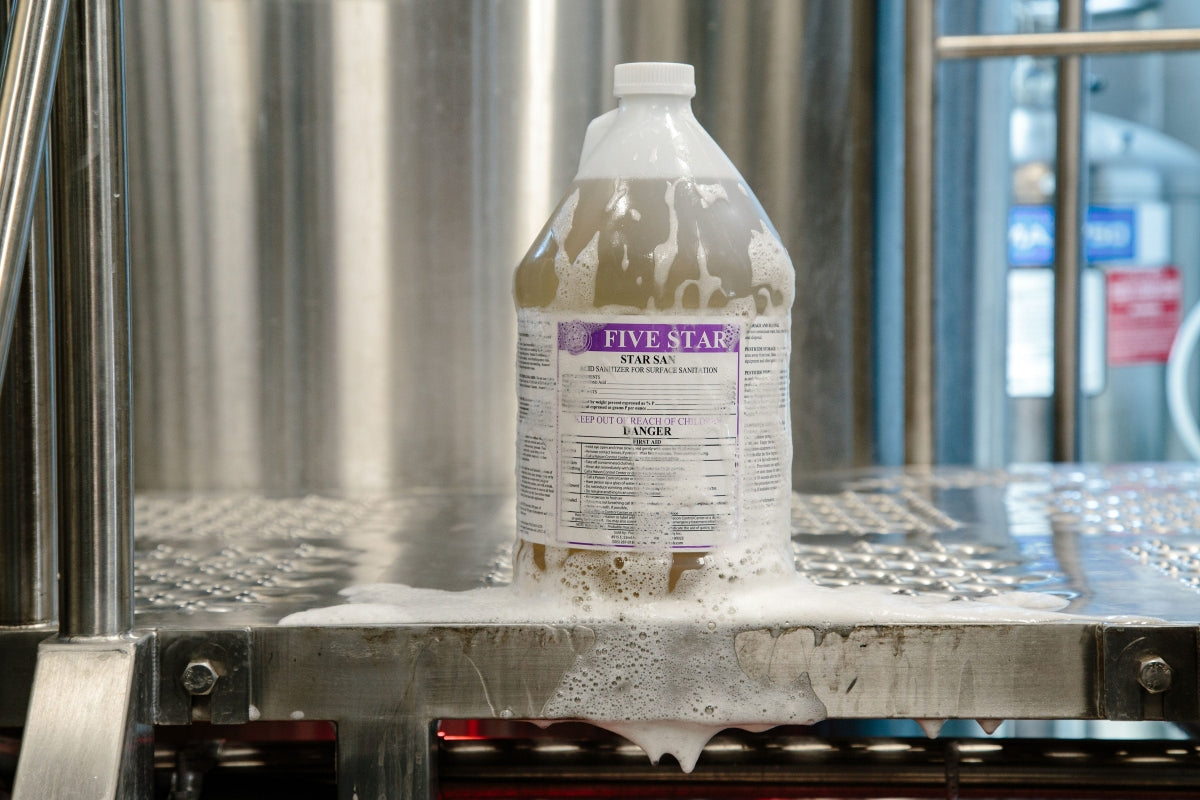
Star San from Five Star Chemicals is a no-rinse sanitiser that lowers the pH of the surfaces it comes into contact with. This means microorganisms cannot thrive. Star San also contains an ingredient that creates lots of foam, which helps it reach every nook and cranny where nasties can lurk. Chemipro San works in the same way and is a sanitiser with a near-identical function. A good alternative from another manufacturer.
Saniclean is a similar product from the same manufacturer as Star San, but without the ability to foam. A contact time of at least 2 minutes is therefore recommended, compared with 30 seconds for Star San. Since it does not foam, Saniclean can be recommended for soaking or CIP (Clean In Place), for example.
Feel free to keep a spray bottle of ready-mixed Star San or similar on hand for quick use.
Clean In Place (CIP)
CIP is a term you have probably heard. Put simply, it means “Clean In Place”: washing a permanently installed brewing machine or fermenter where it stands. This is mostly relevant for larger brewing equipment, mainly in stainless steel. The principle is to fit a CIP ball or similar (rotating spray ball) in the tank to be washed and pump water and cleaner through it. Heat, cleaner and water pressure do all the work for you. You can then spend your time on things other than washing.
Cleaner for hoses and beer lines
For cleaning hoses and beer lines we can recommend Pipeline. This is a chlorine-based cleaner specially designed for cleaning hoses. Perfect for beer lines, transfer hoses, Lindr coolers, kegerators, the Duofiller, BeerGun and much more.
Pipeline also has a unique property in that it changes colour as it works. Put simply: it is pumped through your hose system and left for a few minutes. After this time, what comes out will have changed colour from purple to grey-green. This means it has done its job. Repeat this until the colour stays purple, which indicates that the lines are clean and ready to use again. This cleaner can really work wonders if your tap is giving the beer an unpleasant taste.
Protective equipment: Your safety
Now that we are talking about chemicals, we cannot avoid protective equipment. Strong acids and alkalis are not something you want on your skin or in your eyes. We therefore very strongly recommend a small investment in good gloves and eye protection. Read the safety instructions on the packaging of all chemicals carefully.
Also bear in mind that some surfaces do not combine well with certain cleaners. A typical example is undiluted Star San. It can leave its mark if it leaks onto the kitchen worktop!
Plastic equipment
Plastic fermenters and other plastic equipment can get scratches and scuffs over time or with frequent use. These can be so small that you cannot even see them, but bacteria, yeast and other microorganisms can actually settle there where your cleaner cannot reach. It can therefore be wise to replace them at regular intervals, depending on how often and how they are used, cleaning and storage.
If, for example, you find mould in plastic brewing equipment, it is recommended to replace it before the next brew day. Plastic will also become discoloured, and with frequent use of hot water and cleaners it will become weakened and brittle. Fermenters made of stainless steel and similar materials withstand considerably more and are easy to clean. With good cleaning and maintenance, stainless steel will last so long that it can almost be handed down.
Clever solutions for bottles and kegs
In addition to the completely self-explanatory items such as a wash bucket and bottle brush, dish brush and cloths, there are a good number of aids that can make your cleaning routine more efficient. They may not be essential to the process, but several of the products will definitely make things easier and faster for you:
- Bottle rinser: A good aid for sanitising the inside of bottles without having to soak them in sanitiser.
- Bottle tree: After washing or sanitising bottles, this is a good way to dry them afterwards.
- Jet bottle washer: Connects directly to the tap and gives the inside of the bottles a good flush.
-
Keg Washer: The original Keg Washer lets you wash the inside of kegs without having to spend time scrubbing and soaking. Can also be used for light fermenters and PET containers. An indispensable tool for anyone with Cornelius kegs!
- Fastwasher Rack: A somewhat simpler version of the Keg Washer that is placed in a tub or sink to clean kegs and fermenters.
- Fastwasher: Comes in two versions for cleaning 12 or 24 beer bottles at a time. Requires a tub, sink or FastRack as a container for the wash water.
- FastRack: A system for drying and/or storing clean bottles. Comes in two versions for 12 or 24 bottles, and can be expanded however you like with racks and trays.