A great many homebrewers start out with extract kits before moving on to brewing with fresh ingredients. Extract brewing is a super simple way to brew your own beer and cider!
Quick, cheap and easy
Some will claim that extract brewing will never be as good as brewing with grain. A few years ago there may have been some truth in that claim, but today extract kits are of an entirely different quality. If the brewing process is done correctly with good temperature control, these kits can give you a full-fledged beer.
There are several advantages to brewing with extract kits: it saves time, you need less equipment, and extract brewing is budget-friendly.
The only challenge worth mentioning with extract brewing is that there are fewer opportunities to modify the beer the way you want. You can of course add more hops, fruit, essences or other additions, but it is not possible to take anything out of the finished kit.
What equipment do I need?
To get started brewing extract kits, we recommend Startsett Basic. The package contains almost everything you need, except the extract and beer bottles. Alternatively, we also offer the starter kit Simply Brew, which contains equipment for serving your beer straight from a keg instead. This one also includes an extract kit to get you started.
In brief, you need the following equipment:
- Fermenting bucket with airlock.
- Bottling bucket with tap and bottle filler, which is an extra bucket for separating your finished beer from the yeast and sediment, and then filling the beer into bottles.
- Siphon: For transferring the beer from the fermenting bucket to the bottling bucket.
- Thermometer: For checking the temperature before you add the yeast.
- Hydrometer: For reading the amount of sugar in the beer before fermentation (OG), and for checking that it has fermented out as far as it should after fermentation (FG). With these numbers you can also calculate how much alcohol there is in your finished beer. We will come back to this.
- Brewing spoon: For stirring in the malt extract.
- Caps, bottles and capper.
- Bottle brush, cleaner and sanitiser. Keeping all the equipment clean is extremely important to avoid an infected beer with off-flavours.
- Carbonation drops or priming sugar solution.
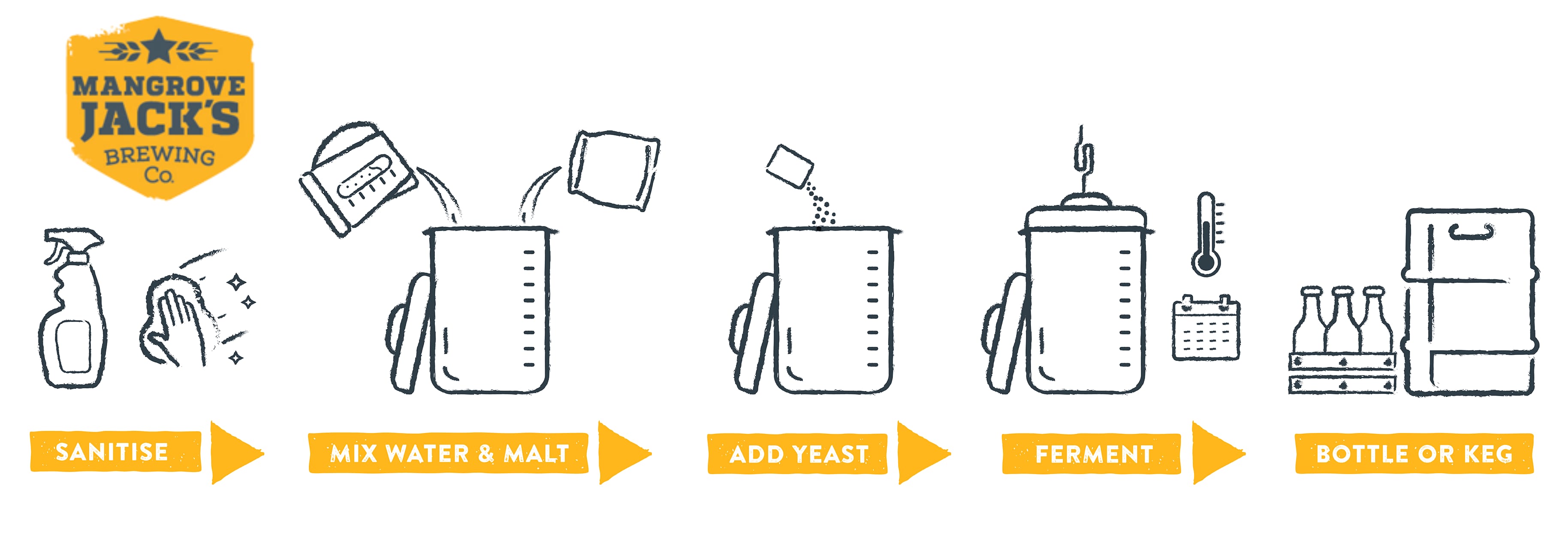
Method for brewing beer with extract kits:
- Pour a couple of litres of water into the fermenting bucket along with a splash of Star San (sanitiser). The amount of Star San is stated on the bottle. Put the lid on and shake well. This is to remove bacteria. Feel free to put everything that will come into contact with the beer in the same bucket to sanitise it at the same time. Leave it for a few minutes and pour out the liquid.
- Bring a few litres of water to the boil. The amount is given in the instructions that come with the extract kit. Pour this into the fermenting bucket together with the extract, and mix it well.
- Top up with cold water until you have the specified amount in the fermenter according to the instructions.
- Stir well, and take a reading with the hydrometer to check how much sugar you have. You will need this number (OG = Original Gravity) later to work out how much alcohol is in the beer.
- Check that the temperature is correct according to the included instructions, and sprinkle over the yeast that comes with the kit.
- Put the lid on and shake well to mix in the yeast. Then fit the airlock filled with sterile water or Star San solution, and leave it for at least two weeks. Make sure the temperature stays stable throughout, so the yeast can work under the right conditions.
- After the fermentation time is up, you can take a new reading with the hydrometer. Check the instructions to see what number it should end at (FG = Final Gravity). It may be a few points above or below, but to be completely sure, it is recommended to take readings 2–3 days in a row. If it has not changed, the beer has finished fermenting and is ready for bottling.
- Repeat the sanitising process with Star San, but this time on all the bottling equipment. Also remember the bottling bucket, bottle filler and not least bottles and caps.
- Use the siphon to transfer the finished beer from the fermenter to the bottling bucket. Avoid splashing, as this can introduce oxygen into the beer. If you are bottling with priming sugar solution, it should be gently stirred into the beer now. For simplicity, we will talk about carbonation drops for the rest of this article.
- Place the bottling bucket on the edge of a table and attach the bottle filler with the spring-loaded tip. Put the bottle on the filler and fill it right up. When you remove the filler from the bottle, it stops by itself, and you get the perfect fill level in the bottle.
- Put one carbonation drop in each bottle and fit a sanitised cap.
- Now the beer needs to condition and carbonate. The yeast will eat the small amount of sugar the carbonation drops add and produce CO2/carbonation in your beer. Leave it for at least two weeks at room temperature.
- After about two weeks you can chill a bottle and taste your very own homebrewed beer!
How do you measure the alcohol in the beer?
To measure how much alcohol there is in your finished beer, you need to use a hydrometer to measure the amount of sugar (gravity) in the beer. This is called an OG reading (OG stands for Original Gravity). You also need to take a reading after fermentation. That reading is called FG (Final Gravity). There are several calculators online that can work this out for you, unless you would rather do it manually with the following formula: ABV% ≈ (OG − FG) × 131.25. Example: (1.050 − 1.010) × 131.25 = 5.25 %.
Sugar or malt extract
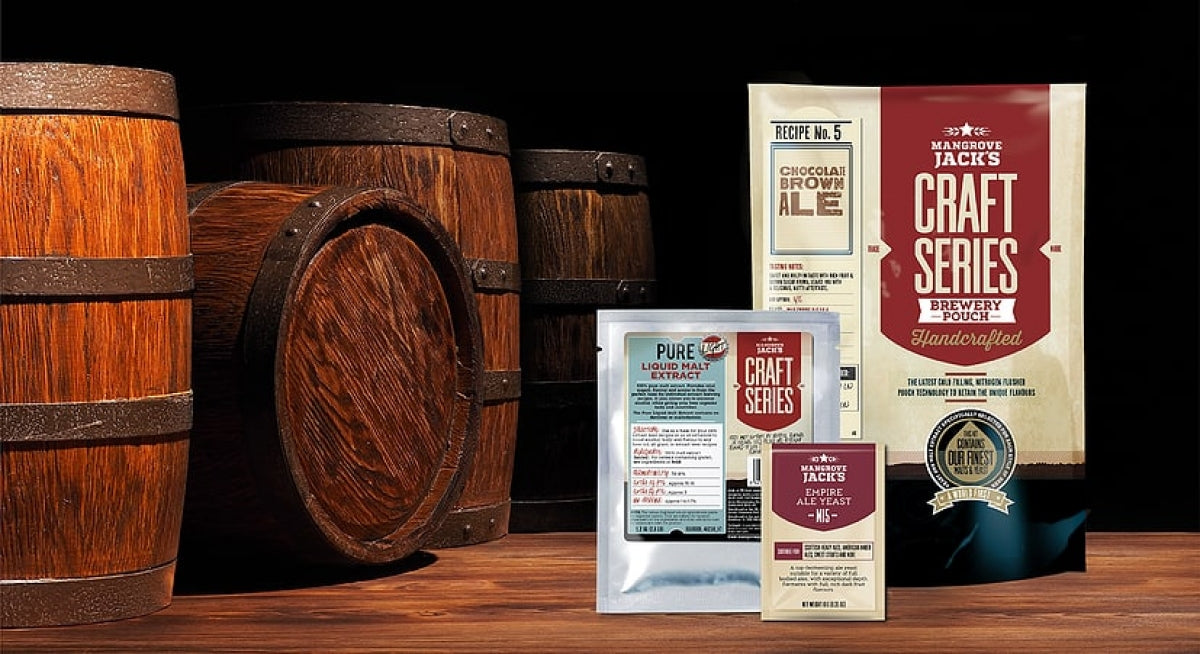
Some extract kits, for example Youngs, come complete, and you do not need any extra additions. Other types, such as Mangrove Jacks Craft Series, need extra malt extract or sugar to reach the right alcohol percentage. For beer kits we recommend using malt extract. It is perfectly possible to use sugar for this, but remember that pure sugar ferments out and only adds alcohol. The beer can then become thin, and often a little “boozy” in flavour.
The malt extract from Mangrove Jacks comes in two sizes: Malt extract 1200g and malt extract 600g, and will always be the right amount for the kits. These also contain dextrins, which the yeast does not ferment (the maltose in the extract is fermented, the dextrins remain). They will therefore give a fuller and more flavourful beer. Check the specific kit to find out how much you need. If you are brewing one of our gluten-free extract kits, you should use sugar, as Mangrove Jacks malt extract contains gluten.
Extract kits for cider
Cider extract kits follow exactly the same method as beer kits. The difference is that we do not recommend malt extract, but use sugar or Mangrove Jack´s Cider Enhancer instead, which adds more mouthfeel and flavour.