There are several different brewing methods, and as a beginner all the strange terms can be very confusing. In this article we go through the most common methods.
Extract kits
A great many people start their brewing career with an extract kit. This is a simple and inexpensive brewing method that does not require much equipment. In short, it is ready-made wort, including all the hops and any additions. This means that all you have to do is dilute hopped malt extract with water and add yeast.
The quality of these kits has improved considerably in recent years, and they can often be a fully-fledged alternative to brewing with fresh ingredients. The only downside to this solution is that the kits are finished as they are. You can of course add more hops or other flavours, but you cannot remove anything from the finished base.
Brewing beer with malt extract
Brewing with malt extract has a lot in common with extract kits. Unlike a ready-made kit, liquid malt extract (LME) usually contains only malt. This means you have greater freedom to combine different kinds of malt extract, hops and, not least, yeast. That way you create your very own recipe.
With this brewing method you simply skip the mash step. So you do not have to think about malt, milling or dust, and you can be sure of getting the correct yield every time.
Note! Make sure you boil the hops to get the right bitterness.
Partial mash
Many people also use malt extract as a base which they combine with specialty malt. In short, this means you make a «mini mash», often on the kitchen stove, with specialty malt only. You still have to mash/steep the specialty malt, but in considerably smaller quantities.
Once you have done that, you use the liquid to dilute the malt extract. This saves you space, mess and work, and minimises the risk of poor yield. At the same time, you can experiment much more with several malt types.
BIAB – Brew In A Bag
Now we move on to brewing beer with real grain instead of malt extract. BIAB, or Brew In A Bag, is exactly that: brewing in a bag. The crushed malt is placed in a fine-mesh bag, often made of nylon or a similar material, and lowered into a pot of water to mash. When the mash time is over, the bag is lifted out and rinsed (sparged) to extract the last of the sugar. This is a very simple and, not least, inexpensive brewing method that many beginners start with.
You do not need an expensive brewing machine, and you can use a completely ordinary large stock pot. If you want to make your brew day easier, you can invest in a proper brew kettle with a ball valve for easy draining. These can be modified however you like with valves, thermometers and cooling systems. If this sounds like the method for you, take a look at our brew in a bag starter kit.

Brewing machines: Compact brewers, patio brewers and all-in-one brewers
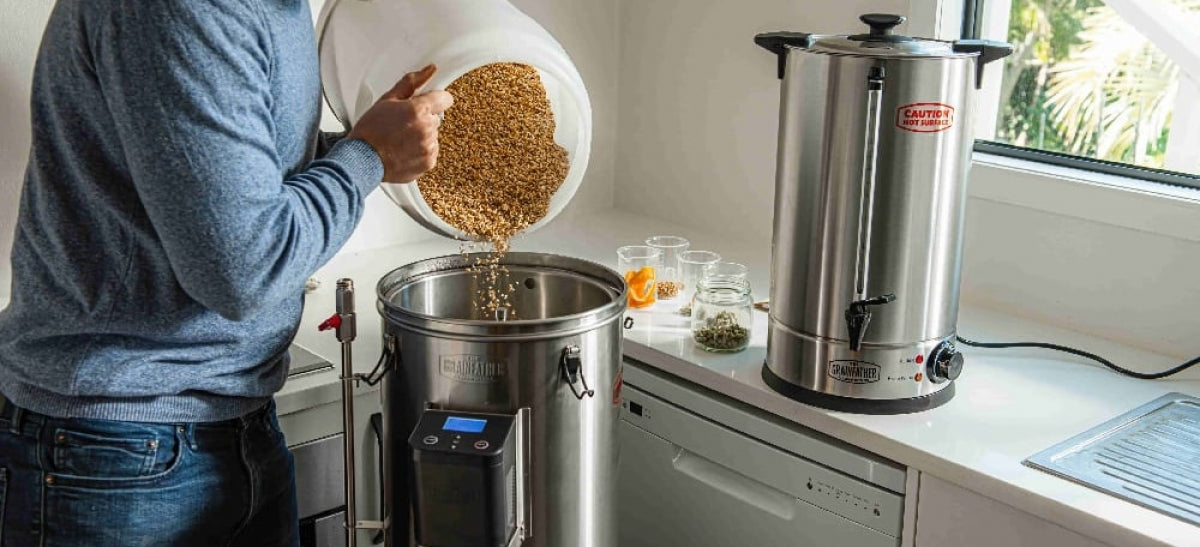
A beloved child has many names, but compact brewer, or simply “brewing machine”, is probably the best known. These machines are fully or semi-automatic brewing machines. Basically, these machines work in the same way as BIAB, but with a number of upgrades that make brewing easier and take up less space.
What characterises a brewing machine:
- A stainless steel malt pipe instead of a bag, which can be placed on top of the brewing machine for sparging.
- Most have built-in pumps for recirculation during the mash and for transferring wort.
- Built-in heating element.
- Digital control of temperature and pump.
Popular brewing machines
Brewing machines come in different price ranges and sizes. They also have different solutions, each with its own advantages and disadvantages. For beginners, the most affordable machines are a good first step into the brewing world. You can then upgrade as you gain insight into which features and sizes you want.
Here are some of the most popular brewing machines, which we consider favourites among homebrewers:
- Brewster Beacon is our most affordable model, and is available in both 40 and 70 litre sizes. This is a very reasonably priced machine with a built-in pump, and a perfect place to start your homebrewing career.
- Grainfather are our most popular brewing machines, available in 30, 40 and 70 litre versions. These are durable machines that can be controlled via Bluetooth/Wi-Fi. With the app you can also enter recipes that let the Grainfather tell you what to do as you brew, and when to add what. A counterflow chiller is also included in the package.
- Speidel #Braumeister Plus comes in 20 and 50 litre sizes, as well as 200, 500 and 1000 litres for craft breweries. This is German quality at its best, with integrated Wi-Fi and a cooling jacket for easy chilling of your finished brew. The new machines are even so precise on temperature that you can buy a «fermentation kit» to carry out fermentation directly in the brewing machine.
- Camurri CB100 is true Italian premium, with a capacity of over 100 litres of beer. The Camurri has a built-in motorised stirrer, which no other compact brewer has. This is the same solution many professional breweries use, and it gives temperature control and yield that few can match.
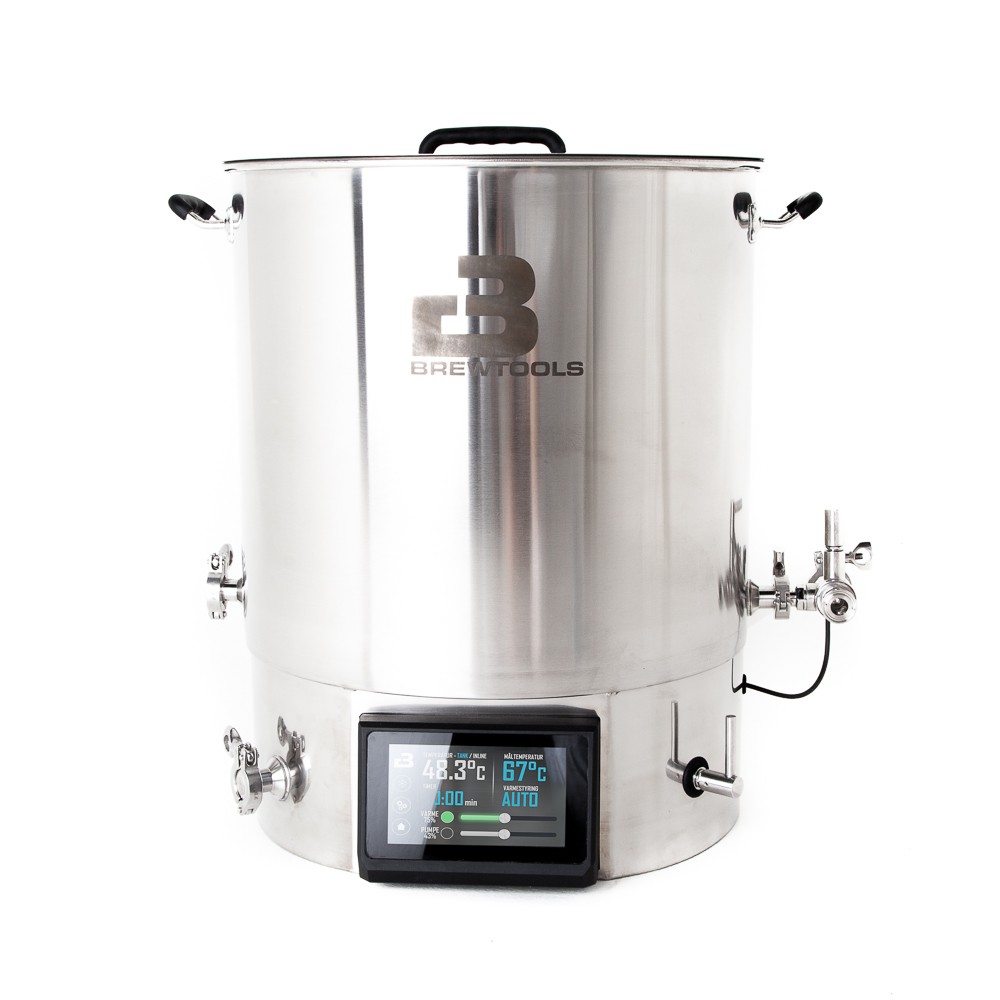
- Brewtools is a Norwegian-made and relatively new high-quality machine, available in 40, 80 or 150 litres (B40Pro, B80Pro and B150Pro). The latter has also become a popular brewing machine for pilot brewing at many breweries. The biggest advantage of Brewtools is that they are highly modular. This means you can build and use them exactly the way you want. The range of accessories is enormous and constantly growing. These are the machines for those who have been brewing for a while, and for those who like to make their own modifications and find clever solutions.
HERMS - Heat Exchanged Recirculating Mash System
HERMS is the brewing system for advanced brewers, and for many homebrewers it is the big dream. One of the great advantages of this system is that the wort never comes into contact with the heating element. This means you have full control of the temperature during the mash, and you avoid anything getting scorched. Hence the name HERMS, or heat-exchanged recirculating system.
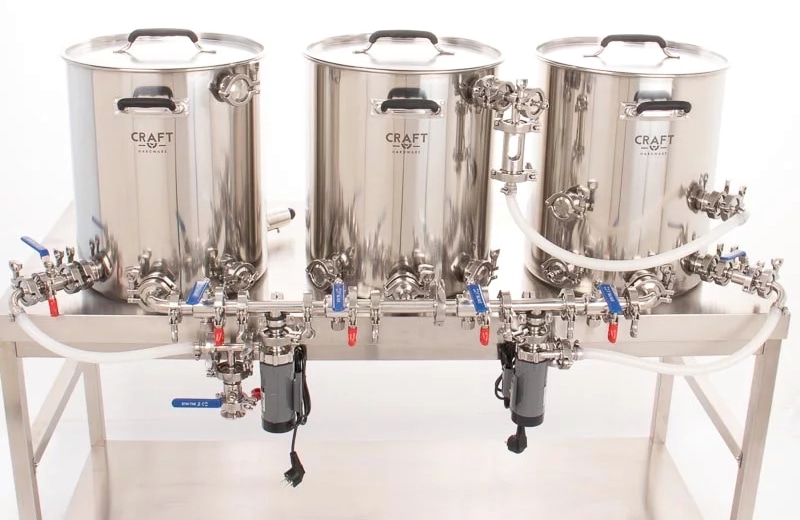
The HERMS brewing system is a highly modular system that you can build exactly the way you want, and make as expensive or inexpensive as you like. Alternatively, there are also ready-made systems, such as our system from Craft Hardware, which you can assemble yourself. So there is no single right answer for how the process works, but we can try to explain the concept in a simple way:
HERMS usually consists of three vessels and generally one or more pumps. These vessels, the mash tun, the boil kettle and the hot liquor tank (HLT), each have their own function.
The mash tun is usually well insulated to hold the temperature during the mash. As the name suggests, this is where the mash takes place. This vessel has no heating element, but instead a HERMS coil that runs out of the mash tun and through the hot liquor tank (HLT) to hold the temperature there. A false bottom is usually used instead of a malt pipe or bag that has to be lifted out. Here the wort is transferred to the vessel, then sparged directly in the mash tun, before being pumped over to the boil kettle.
The hot liquor tank (HLT) usually has a heating element that can heat water quickly and efficiently. This water holds the mash temperature along the way, and it is this water that is used for sparging after the mash is finished.
The boil kettle is mainly used to boil the wort after mashing. Since the boil kettle is not in contact with the mash, it can have very powerful heating elements.
RIMS Recirculating Infusion Mash System
RIMS works in almost the same way as HERMS. Instead of an element sitting in the bottom of the kettle (as on compact brewers), or the wort circulating through a separate vessel (as in a HERMS system), the wort is pumped through a separate tube with a built-in heating element. This means you heat the wort while it circulates through a tube outside the kettle.
The difference between RIMS and HERMS – put simply:
- The HERMS system adjusts the temperature by switching the pump on and off.
- In the RIMS system the pump runs continuously, while the temperature is controlled by switching the heating element on and off.
As with HERMS, there are a great many options for how to build your system, letting creative builders and brewers express themselves.
We hope this short guide has given you an insight into the different brewing methods and can help you work out which one suits you best. If there is anything you are wondering about, just get in touch with us.