Why oxygenate the wort?
Oxygen plays a crucial role in the health and performance of the yeast during fermentation. It gives the yeast the building blocks it needs to produce cell membranes and ensure healthy growth. Without sufficient oxygenation you risk:
- Poor attenuation: The yeast may struggle to consume the sugar in the wort.
- Slow or uneven fermentation: This can lead to varying flavour profiles.
- Unwanted flavour and aroma compounds: Problems during fermentation can produce by-products that affect the flavour of the beer negatively.
- Yeast that cannot be reused: The yeast can become weak and unsuitable for harvesting.
Even though modern yeast often comes with enough reserves for one round of fermentation, sufficient oxygenation will ensure better performance, especially for beers with a high OG (original gravity) and lagers.
How do you oxygenate the wort?
To achieve optimal oxygenation of the wort, the right equipment and technique are essential:
1. Oxygen regulator
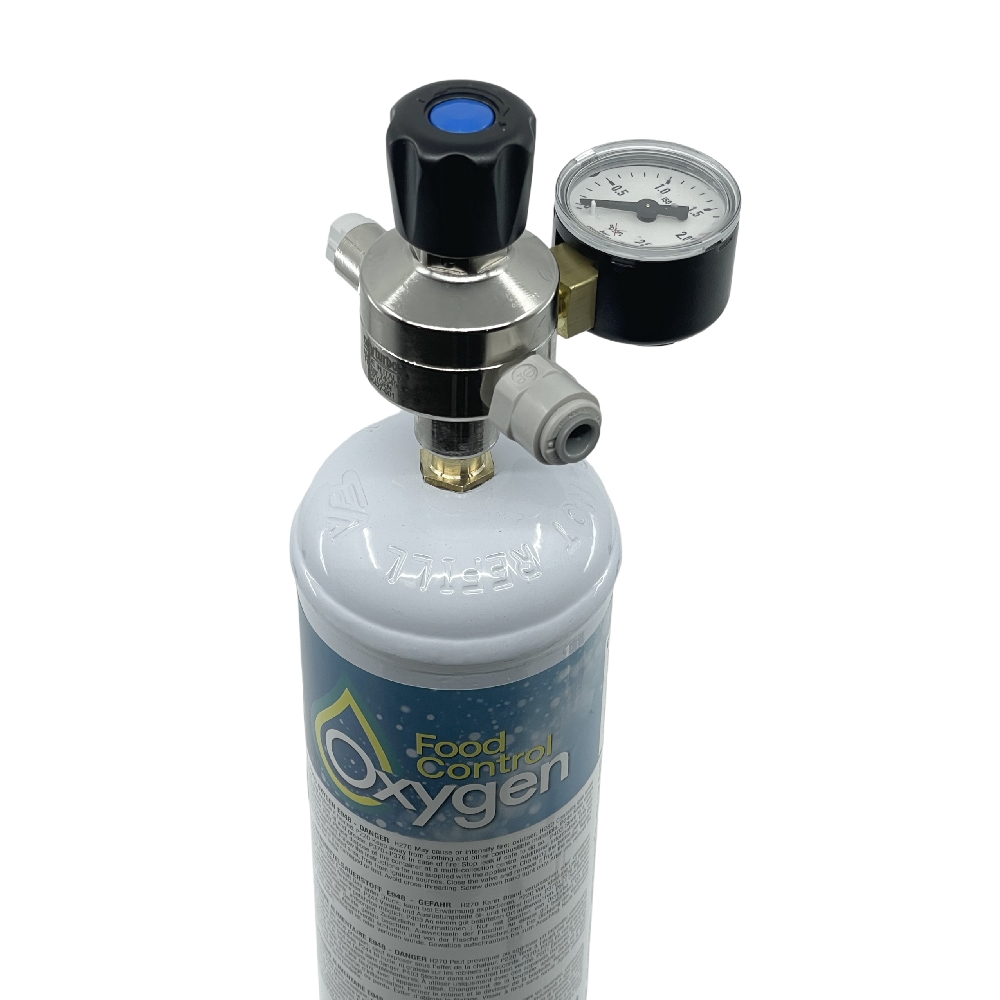
When using pure oxygen, an oxygen regulator is necessary to control pressure and flow. The recommended pressure is between 0.5 and 1 bar, which gives a steady supply without oversaturation.
2. Oxygenation stone
An oxygenation stone with 0.5-micron pores produces microscopic bubbles that are easily absorbed into the wort. Without this equipment, large bubbles will quickly rise to the surface without dissolving.
3. Flow meter for precise measurement
A flow meter makes it possible to control the oxygen supply precisely. For a 25-litre batch the following is recommended:
- Ales up to 1.060 OG: 8 ppm oxygen, at 1 litre per minute for 80 seconds.
- Ales above 1.060 OG and lagers: 14 ppm oxygen, at 1 litre per minute for 160 seconds.
When should oxygen be added?
Oxygen must only be added before the yeast is pitched. In this phase, known as the cell growth phase, the yeast uses oxygen to reproduce and establish a robust population. Once fermentation has started, oxygen should never be added, as this can lead to oxidation and unwanted flavours.
Is oxygenation always necessary?
The answer depends on the beer style, the batch size and which yeast you use. Some homebrewers and breweries with smaller batches can get away with minimal oxygen levels when using modern yeast. But for larger batches, stronger beers and lagers, oxygenation will still be crucial for achieving a high-quality result.
The benefits of oxygenation in practice
Professional breweries often oxygenate to achieve consistency and quality in every batch. They know that correct oxygenation gives:
- Shorter fermentation time
- Cleaner flavour profiles
- A higher yield of yeast for reuse
For homebrewers who want to take their beer to the next level, oxygenation is a simple but very effective way to improve results.
Oxygenation equipment – what do you need?
At Brewshop you will find everything you need for effective oxygenation:
- Oxygen bottle with food-grade oxygen
- Oxygen regulator for precise control.
- 0.5-micron oxygenation stone / diffusion stone for effective dissolution.
- Flow meter for precise oxygen supply, if this is not integrated in the oxygen regulator.
Conclusion: Do not underestimate the role of oxygen
Even though today's modern yeast is robust, oxygenation gives you extra assurance of achieving perfect fermentation and fantastic beer. By using the right equipment and following the recommended guidelines, you can ensure optimal conditions for the yeast and raise the quality of your brew.
By the way, did you know that Brewshop is the first in Norway to launch food-grade oxygen for homebrewers? Check out Oxyturbo disposable bottles with food-grade oxygen. Now you never again need to use technical gas, which is intended for welding equipment, in your beer.