Traditional lager fermentation requires 10–12°C for two to three weeks, followed by several more weeks of conditioning. For most homebrewers, that is the very reason the pilsner never gets brewed: there is nowhere in the house that holds 11°C, and a fermentation fridge costs both space and money.
High Voltage turns the problem on its head. It is a thermotolerant kveik from the Irish WHC Lab that ferments at 31–35°C and is finished after two to three days, while giving such a clean flavour profile that the beer reads as a lager. Instead of cooling down, you heat up.
In short
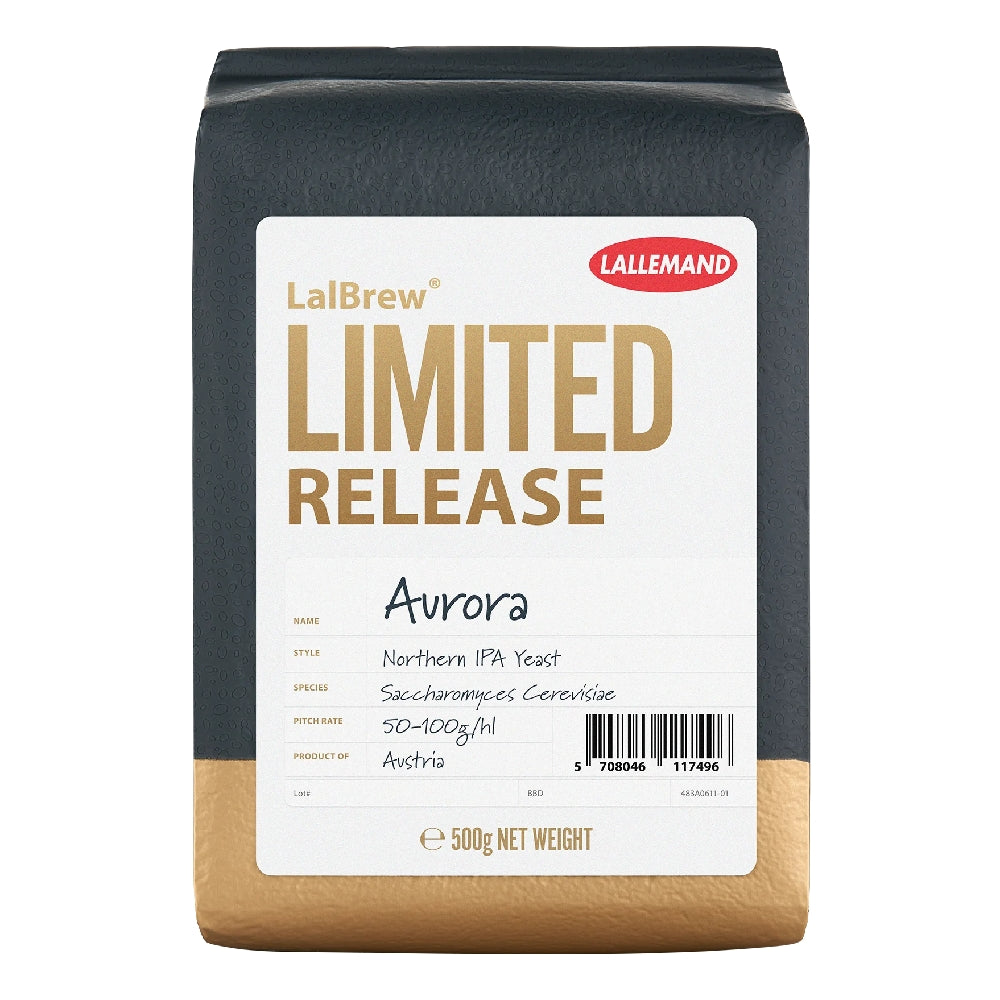
High Voltage is a dry yeast (kveik) from WHC Lab that ferments out in 2–3 days at 31–35°C and produces next to no esters. That makes it possible to brew pilsner, helles and other pale lagers without a fridge, fermentation chamber or glycol chiller. One 11 g sachet covers 20–25 litres. Attenuation 76–80 %, high flocculation, alcohol tolerance 17 %. The yeast is of the same type as Lutra Kveik.
Why does ordinary lager take so long?
Lager yeast (Saccharomyces pastorianus) is adapted to the cold. At 10–12°C it works slowly and calmly, and that is precisely why it produces very few esters and fusel alcohols. The clean, neutral profile we associate with pilsner is therefore a direct consequence of low temperature.
The price is time. A lager typically needs 12–21 days of fermentation, a diacetyl rest towards the end, and then three to six weeks of cold conditioning. If you raise the temperature on a regular lager yeast to speed things up, you get fruity esters instead, and often a distinct buttery note of diacetyl.
Kveik is a different matter. These farmhouse yeasts from Western Norway have been selected over generations to ferment fast and hot, and several of the modern, isolated strains produce very few esters even at 35°C. Read more about what kveik is and how it behaves.
What is High Voltage?
High Voltage is a dried kveik strain from WHC Lab, marketed as «electrifyingly clean thermotolerant yeast». It was selected for two properties that rarely occur together: it tolerates high temperatures, and it creates almost no yeast character. Malt and hops get to stand on their own.
The yeast is of the same type as Lutra Kveik from Omega Yeast, which is the best-known «pseudo-lager» kveik on the market.
Technical properties
| Recommended fermentation temperature | 31–35°C |
| Fermentation time | 2–3 days at 34–37°C |
| Attenuation | 76–80 % |
| Flocculation | High |
| Alcohol tolerance | 17 % |
| Dosage | 3–10 g per 10 litres |
| Pack size | 11 g dry yeast |
The alcohol tolerance of 17 % is worth noting. It is high enough for the yeast to also be used for hard seltzer and strong stouts, where ordinary ale yeast gives up.
Can kveik really give lager character?
That is the reasonable question, and there is actually research on it.
In a study published in the journal Fermentation in 2022, Habschied and colleagues fermented identical worts with Lutra kveik at 21°C and 35°C respectively. At 21°C fermentation took nine days. At 35°C it was finished in two. Both beers were recognised as lagers by the sensory panel, and the physico-chemical quality indicators were in line with conventional lager. Diacetyl was below the detection threshold in both samples.
Even more convincing is a blind test from Brülosophy, in which 51 participants were served a German pils fermented with Lutra kveik at 19°C against the same pils fermented with Saflager W-34/70 at 11°C. 23 of 51 managed to pick out the odd sample, which is just below the threshold for statistical significance. The conclusion was that the tasters could not reliably tell the two beers apart.
Note that both studies were done on Lutra, not on High Voltage directly. Since it is the same type of yeast with the same application, the findings are nevertheless the best documentation available that the method works.
One finding in the study deserves attention: DMS was above the recommended threshold in both samples. DMS gives a note of cooked corn and comes from pilsner malt, not from the yeast. You control it with a vigorous, uncovered boil of at least 60 minutes and rapid chilling afterwards. If you brew with a Fresh Wort Kit, the wort has already been boiled by us, and the problem is not yours.
How to brew pilsner with High Voltage
1. Get heat, not cooling
This is the only real adjustment. A Norwegian room rarely holds 33°C on its own, so you need a heat source. A Project Brew Varmematte 30W is fastened with Velcro around the fermenter and controlled by an Inkbird WIFI ITC-308. For 60–80 litre tanks, use the 100W XL heat mat.
If you do not have a heat mat, you can get a long way with a small room, a fan heater and a temperature controller. The point is that the temperature should be stable for three days, not that the equipment should be fancy.
A practical detail many people trip over: the self-adhesive thermometer strips for fermenting buckets only read up to 28°C, making them useless in this temperature range. Use the probe from the temperature controller instead, taped to the side of the fermenter under insulation.
2. Dose and pitch
One 11 g sachet covers a normal batch of 20–25 litres. If you are brewing above about 6.5 %, use two sachets. The yeast can be sprinkled directly onto the wort without rehydration.
Pitch at fermentation temperature, i.e. around 33°C. This is where kveik differs from everything else: you should not chill the wort down to 20°C first. That saves both time and cooling water.
3. Leave it alone
Fermentation typically starts within two to four hours and is vigorous during the first day. Make sure there is plenty of headspace, or use a blow-off. After two to three days it is finished. Check with a hydrometer, not the clock. Do not use a refractometer once fermentation is under way: alcohol refracts light differently from sugar, and the reading will be wrong.
High flocculation means the yeast drops out by itself when it is done. A few days cold afterwards gives a clear beer, but is not necessary for the sake of flavour.
4. Pressure fermentation, if you have the option
Warm, fast fermentation goes well together with pressure. A back pressure of 0.7–1 bar suppresses the few esters the yeast produces, and you can carbonate and serve from the same tank without the beer coming into contact with air. An Apollo 30L Snub Nose pressure fermenter is an affordable place to start. You also need a spunding valve to regulate the pressure, for example the Spundy Compact Spunding Valve.
What can you brew with High Voltage?
The easiest way in is the Pilsner Lite 20L Fresh Wort Kit. The kit comes with High Voltage in the box and contains 20 litres of ready water-adjusted wort that should not be diluted with water. The wort has glucoamylase added, which breaks down dextrins into fermentable sugars and gives a dry, low-carb beer based on pilsner malt and Saaz hops. Fully fermented in three days.
If you want more malt and bitterness, the Bohemian Pilsner 20L Fresh Wort Kit works well with High Voltage, even though the kit comes with a different yeast.
If you brew all-grain, the yeast works across the whole pale lager spectrum: pilsner, helles, münchner, kölsch and Mexican lager. See the range of all-grain beer kits.
It is not limited to pale beers. WHC lists styles from NEIPA and West Coast IPA to imperial stout and bock. In hop-driven beers the neutral profile is an advantage: the hops get to take centre stage without the yeast adding its own character on top.
High Voltage compared with the alternatives
| Yeast | Temperature | Fermentation time |
|---|---|---|
| High Voltage (kveik) | 31–35°C | 2–3 days |
| Lutra Kveik | 20–35°C | 2–4 days |
| LalBrew NovaLager | 12–20°C | 1–2 weeks |
| SafLager W-34/70 (lager yeast) | 10–12°C | 2–3 weeks + conditioning |
In practice the choice is between providing heat or providing cold. If you can hold 18–20°C in a basement, LalBrew NovaLager is a good alternative that is a true lager yeast. If you have neither a basement nor a fridge, but a warm room and a heat mat, High Voltage is faster and simpler.
Common mistakes
Temperature too low. Below 25°C fermentation becomes sluggish, and the kveik starts giving off the fruitiness you are trying to avoid. Stay at 31–35°C.
Packaging by the clock. Three days is a rule of thumb, not a guarantee. Always measure the final gravity, and measure twice a day apart before you package.
Too little headspace. Fermentation at 34°C is vigorous, and a full fermenter without a blow-off ends up on the ceiling.
Chilling the wort first. Unnecessary. Pitch warm and save the time.
Get started
The fastest route to a pilsner is the Pilsner Lite 20L Fresh Wort Kit with High Voltage in the box. If you already have your wort ready, all you need is High Voltage 11 g, a heat mat and a temperature controller.
If you want to read more about why temperature matters so much during fermentation, we have written about it here.
Sources
- Habschied, K., Krstanović, V., Šarić, G., Ćosić, I. and Mastanjević, K. (2022): «Pseudo-Lager – Brewing with Lutra® Kveik Yeast», Fermentation 8(8), 410.
- Brülosophy, The Brü Club xBmt Series (2022): «Yeast Comparison: Omega Yeast OYL-071 Lutra Kveik vs. Saflager W-34/70 In A German Pils».
- WHC Lab, technical data sheet for High Voltage.